TL;DR
I/O 2026 wasn't a model launch. It was Google quietly bolting seven products together into one agent runtime while everyone else was busy arguing about benchmark scores. Below: each piece, a short example of what it actually does, and an honest note on what's shipping versus still in preview.
Why I'm writing this
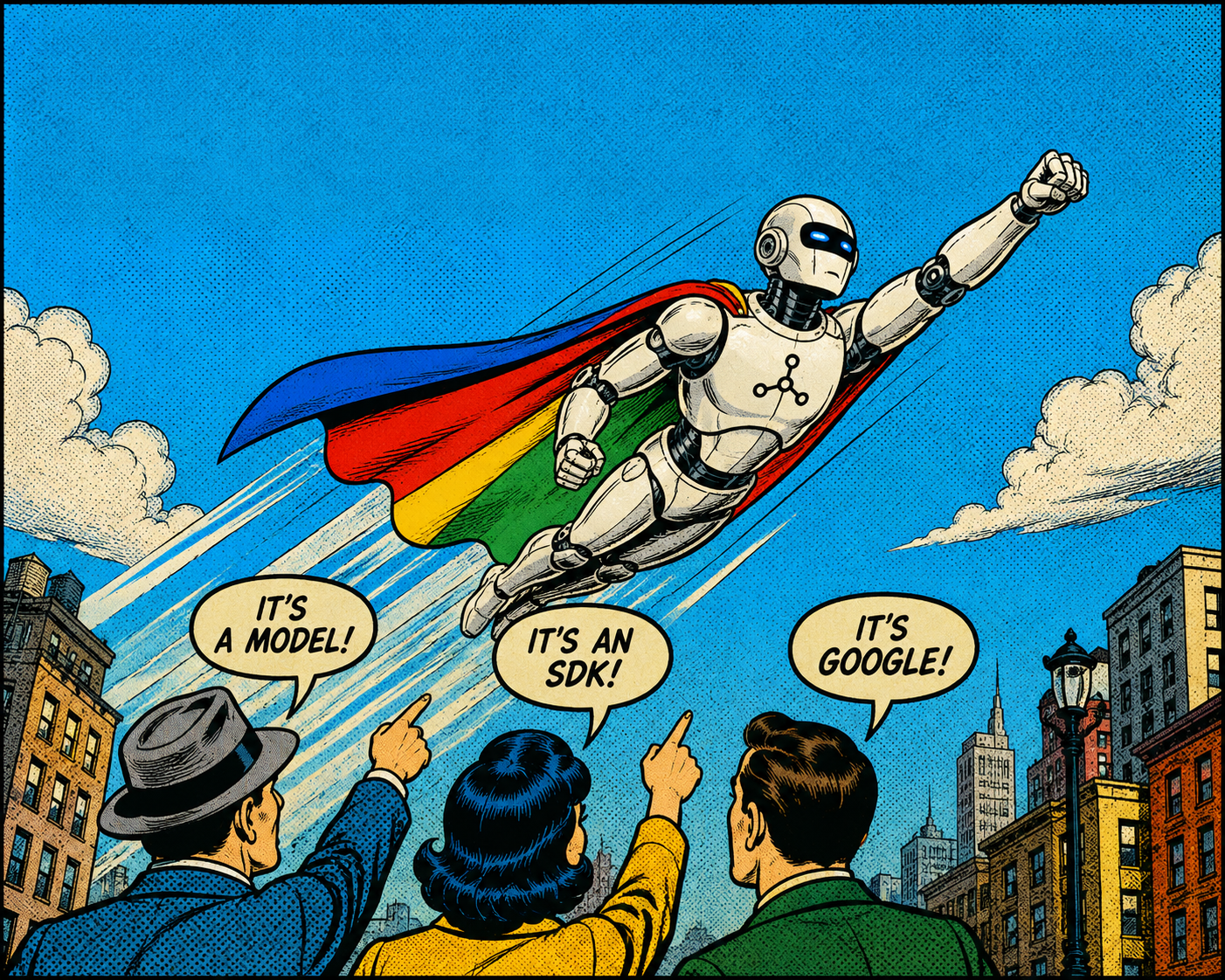
Look, up in the sky! Is it Openclaw? No. Is it Cursorpilot? No. It's Google I/O 2026, and somehow the boring one in the back is the team that finally shipped an actual agent runtime.
I watched the keynote twice. The first time I came away with the same takeaway as most recaps: Gemini 3.5 Flash is faster, cheaper, has configurable thinking. Fine. True. Also boring.
The second time I noticed something else. Google didn't ship a model. Google shipped a runtime. Seven pieces that, stitched together, let an agent plan a task, run code in a sandbox, click around the web, ask a human for approval, and email the result. That's the story nobody wrote on day one. So I'm writing it.
The stack at a glance
                ┌─────────────────────────────────────────────┐
  Surfaces      │   Spark      WebMCP       Search mini-apps  │
  (where you    │  (Workspace) (browser)        (AI Mode)     │
   meet it)     └─────────────────────────────────────────────┘
                                    ▲
                ┌─────────────────────────────────────────────┐
                │           Antigravity SDK                   │  bring your own infra
                ├─────────────────────────────────────────────┤
  Runtime       │           Managed Agents API                │  isolated sandbox
                ├─────────────────────────────────────────────┤
                │       Antigravity 2.0  +  Antigravity CLI   │  orchestration
                ├─────────────────────────────────────────────┤
                │              Gemini 3.5 Flash               │  the brain
                └─────────────────────────────────────────────┘
Four foundation layers. Three surfaces where the runtime touches a human. Bottom-up, one piece at a time.
1. Gemini 3.5 Flash, the brain
The model. Reads your request, picks the next step, writes it.
Faster than a speeding bullet, with a new twist: you can tell it "this one's tricky, think harder" by raising the thinking budget. Sandwich-level questions stay cheap. Thanksgiving-level questions get the deeper pass.
Ask it to summarize my unread Slack into 5 bullets and you get the bullets in under a second. Ask it to find the bug in this 800-line function and it bumps thinking up, takes 20 seconds, and gives you a real answer instead of a confident guess.
Why this matters: every layer above assumes the brain is fast enough to sit inside a loop without being the bottleneck. 3.5 Flash is the first Google model designed for that loop, not for one-shot chat replies.
Reality check: shipping in AI Studio. Configurable thinking levels in the API.
2. Antigravity 2.0 + CLI, the orchestrator
The thing that turns a goal into a plan.
Picture our hero splitting into half a dozen copies, each handling one piece of the job, each reporting back with a Polaroid before they vanish. That's the gist. Antigravity takes a goal, breaks it into steps, spawns sub-agents in parallel, runs each step in a sandbox, and captures artifacts (screenshots, recordings, diffs) so you can verify the work without re-running it.
Ask it to ship a fix for the login bug. It opens the repo, reproduces the bug, writes a test, writes the fix, runs the test, captures a before/after screenshot, opens a PR. You see the screenshot, hit approve, the PR merges. You never opened your terminal.
The CLI is the same engine wrapped for tmux folks. Sub-agent sandboxing, credential masking, hardened Git policies, both ship with it.
Reality check: 2.0 and CLI are generally available. The end-to-end demo works on curated benchmarks. Real repos surface seams; early launch-week reports mention auth flakiness and the agent occasionally getting stuck in planning loops. Not vapor, but not magic either.
3. Managed Agents API, the isolated sandbox
Where the agent actually runs.
Every hero needs a Phantom Zone where things can blow up without consequences. The Managed Agents API gives each agent a hosted Linux sandbox: it can reason, call tools, execute code, and the rest of your world hears nothing.
Ask it to take this customer-uploaded CSV and produce a clean Parquet file with a summary chart. The agent spins up a sandbox, installs pandas, runs the transformation, exits. The sandbox is destroyed. The CSV never touched your machine. The malicious Python the customer may have buried in a cell never touched anything that mattered.
Sandboxing isn't a nice-to-have. It's the precondition for letting a probabilistic decision-maker execute code on your behalf.
Reality check: in preview. Region-gated. Priced per sandbox-minute. Tear them down quickly.
4. Antigravity SDK, bring your own cape
Same powers. Your costume.
Antigravity's defaults run on Google's infrastructure. Fine for a demo. Not fine if you're a fintech, a hospital, or any team where "agent reasoning traces sit on someone else's servers" is a sentence that ends a meeting.
The SDK is the escape hatch. Programmatic control over the harness: how it plans, which tools it can call, what counts as "done", what gets logged, where the artifacts land. Deploy it on your VPC, your Kubernetes cluster, wherever your auditor can audit it.
Ask it to process this batch of insurance claims, summarize each one, flag anything that looks fraudulent, and never let the model see the full SSN. You write that as a policy. The harness enforces it. The model only ever sees masked data.
Reality check: SDK shipping. BYO-infra deployment in preview. Self-hosting documented but rough.
5. Spark, the mild-mannered version
Now we leave infrastructure and meet the runtime where humans actually work.
Spark lives inside Gmail, Docs, Calendar, and Sheets. Not as a sidebar, not as a button. As background staff. The Clark Kent shift: glasses on, suit pressed, sitting at the next desk all day, drafting easy replies, preparing meeting notes, filing the receipts you forwarded last Tuesday.
Ask it to prep me for the 3pm with Acme. It pulls the email thread, the last meeting notes, the contract draft in Drive, a quick summary of the new attendees from your CRM. Builds a one-page brief in Docs and pins it to the calendar event. You walk in already briefed. You didn't open six tabs.
Spark is Google's bet that the next moat for office software isn't features. It's whether your runtime remembers what you wrote last Thursday.
Reality check: rolling out, region-gated, tier-gated. Drafts are good, sometimes embarrassing. Verify before sending.
6. WebMCP, the standard handshake
The stack works fine while the agent stays inside Google. The problem is the rest of the web.
Most sites don't have APIs. Today's agents fall back to the worst possible workaround: pretending to be a human, clicking around, hoping the layout didn't change overnight. Our hero in disguise, fumbling at the front desk, hoping nobody notices the cape.
WebMCP is the proposed fix. USB-C for websites. Any site publishes a small manifest saying "here are the actions you can take here, here's how to call them, here's the auth you need." The agent reads it and calls the actions directly. No scraping. No fragile selectors.
Ask it to book me a flight to Berlin next Friday, aisle seat, under €400. The airline site replies with a structured list: search_flights, select_seat, pay, get_confirmation. The agent calls them in order, hands you the boarding pass.
This is the only piece of the stack that needs the rest of the world to play along. Google can ship it in Chrome. Adoption is a different problem.
Reality check: Chrome 149 origin trial. Spec still moving. Whether airlines and banks and retailers actually adopt it is the real question.
7. Search as mini-apps, the on-demand UI
The strangest layer and the easiest to underestimate.
Google Search is no longer a list of links. For complex queries in AI Mode, it builds you a custom UI on the fly. Filterable. Interactive. Disposable. Less phone book, more X-ray vision: instead of handing you ten links and wishing you luck, Search looks through the question and builds the answer surface for it on the spot.
Ask it to compare EV lease deals in Berlin under €400/month with a 24-month term. Search doesn't return ten blue links. It builds a sortable table of matching offers with sliders for price and term, and live links to the dealerships. You filter, you decide, you click out.
A mini-app is just a frozen agent run with a UI on top. Search is where most people will first meet that pattern. Not in a developer console. In a search box.
Reality check: live in select markets, mostly English-language queries. Quality varies. Sometimes a real comparator. Sometimes a fancier snippet.
Zoom out
Seven products. One runtime. The brain decides, the orchestrator splits the job, the sandbox keeps the work contained, the SDK lets you fly off the grid. Spark sits at your desk in plain clothes. WebMCP gives the rest of the web a proper handshake. Search hands you a one-off dashboard instead of a phone book.
The product boundary moved. It used to be "open Gmail, then Docs, then Calendar". Now it's "ask for an outcome, the runtime picks the tools". Call that an OS pivot. Google is too polite to.
What I'll be watching next: WebMCP. It's the only piece that needs the rest of the world to agree to anything. Everything else Google can ship on its own. But if WebMCP doesn't catch on outside Google, agents stay locked inside Google products and the whole runtime story becomes a Google story instead of a web story.
If you build agents for a living, the move is the same as ever: pick one of the seven, ship something small with it, find the seams. The cape is shiny right now. The honest question is which of these pieces will still be flying in two years, and which will end up in the Phantom Zone with the other forgotten product launches.
References
- Ken Huang, Google I/O 2026 Was Not Just a Model (the piece that triggered this writeup)
- Google Developers Blog, All the news from the Google I/O 2026 Developer Keynote
- Sundar Pichai's opening keynote
- I/O 2026 Developer Keynote recap